
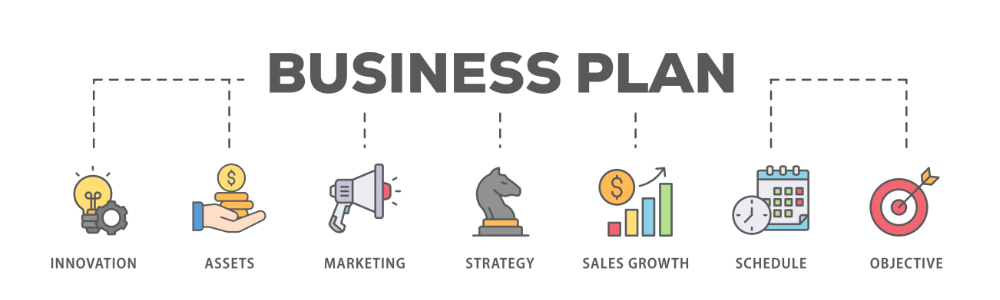
Business planning, regardless of the industry, is like a road map for a company, guiding it towards success. It involves a series of steps aimed at setting goals, devising strategies, and organizing resources to achieve those goals.
First, a business plan starts with a clear vision and mission statement. A vision statement serves as a compass showing external components the direction your business is heading. It is a brief description of a company’s long-term goals. This should be a BIG perspective of the desired outcome, looking 5-10 years out to define the framework for future success. Align it with the business values and goals. Being clear, concise, and aspirational forms a mental picture of planned achievements, giving employees a target to aspire to and resulting in a customer-centric focus.
The mission statement is a brief description of the business tactics used to accomplish the vision. It is a simple and concise way to communicate purpose, focusing on short-term goals and detailing steps as to how the business will achieve its short-term objectives. Action-oriented, it is a method to describe how the business will impact communities, investors, and others, creating the roadmap to vision fulfillment. These statements define the purpose and direction of the business, outlining its values and objectives. They function as guiding principles for all future decisions.
Executive Summary
Start with an overview summarizing every important aspect of your business plan. It may seem like a simple introduction; however, it covers the entire plan, just a shorter version, which includes the business concept, target market, unique selling proposition (USP), and financial projections. Although the Executive Summary appears first in the plan, it’s best to write it once the business plan is complete. Then all that’s required is a review to identify key points to use in the summary.
Description of Business
Detail your product concept, location, and any specifics regarding the product industry, its life cycle (embryo, growth, maturity, decline), the status of the business (startup, expansion, takeover), business form (sole proprietor, partnership, corporation), whether the business is open or when it will open, and hours of operation.
Market Analysis
Identify the product’s unique qualities and research your target market. Comparing the strengths and weaknesses of your competitors to your own business can provide much insight into competitive opportunities and risks.
Using a grid for three or four of your most intense competitors can give an immediate visual. It will tell a better story about your business than that of your competitors (obviously you will know more detail regarding your own organization), so don’t be discouraged if the grid reveals as much for those competitors. However, defining what you do know about the competition and applying it to the grid provides the initial gathering of the much-needed facts for evaluation. (Company Strengths and Weakness Grid-insert link) SWOT analysis (an analysis of the company’s strengths, weaknesses, opportunities, and threats) enables the business owner to construct a balance sheet, another method to weigh factors in your business environment and how those business’ factors stack up to the competition, balancing out what your business should do and when to do it. (insert SWOT grid). Using tools to identify potential obstacles can better define those obstacles and fine-tune the process.
The end gain is knowing your ideal customer, the competition, and how your business fills a gap in the market. Routine analysis of the plan’s performance is critical. Tracking metrics and adjusting as needed both factor into adapting to market changes in the industry. The marketing plan should evolve over time so take advantage of the dynamics of this tool and tweak your business toward success.
Marketing and Sales Strategies
Start by defining the target audience. Understanding their needs and preferences provides the data to tailor strategies and select the best channels based on where your audience is most active, i.e. social media, email, or traditional advertising.
Determine the direction of your business and how you will attract and retain customers. Identify a unique selling proposition (USP) and include it in your business plan. In addition to social media and the better-known strategies to market your product, also consider events and partnership strategies.
Operating Plan
Include your business structure, location, facilities, equipment and technology. Provide information regarding staffing, and relationships with suppliers or partnerships. Identify key suppliers crucial to your day-to-day and long-term operations. If applicable, describe inventory management and supply chain processes. Break down the steps required to produce your product or service. Include any technology, including software, hardware and communication tools, or machinery needed to operate. Quality control measures need to be described to ensure consistency and customer satisfaction.
Discuss how your business complies with regulatory compliance in your industry. Make sure Risk Management is a key focal point in the business plan, outlining potential risks and mitigation strategies.
Management and Organization
This section conveys the structure and leadership of your business. Highlight key members of the management team, their background, skills, and experience. Discuss the organizational structure and responsibilities of each member. Include an organizational chart, illustrating who does what, who reports to whom, and who makes the final decisions. Include relevant salary information for the functional areas of the business, i.e., purchasing, sales, personnel, distribution, advertising, and marketing. Ensure the salaries are realistic and aligned with industry standards. List available resources to conduct business, i.e., accountant, lawyer, insurance agent, business coach. Clearly outline ownership structure, history of the principal(s), experience, education (formal and informal), and special abilities. Also identify external advisors and their roles. This demonstrates a broader network of support. Detail essential personnel, their roles and how their expertise contributes to the success of the company. Include current and future hiring plans and succession planning for leadership or unexpected staffing changes.
Financial Projections
Include detailed financial forecast. Key elements should include startup costs; sales forecast over a specified period of time, a breakdown by product or service categories if applicable; expense budget including operating costs, marketing, salaries and other relevant expenditures; profit and loss statements (income statement); cash flow projections; break-even analysis, financial assumptions and key financial ratios, i.e. profitability ratios, liquidity ratios, and solvency ratios for a deeper understanding of the business’ financial performance; and sensitivity analysis to evaluate the impact certain changes in variables can have on your financial projections.
Funding Requirements
Start by detailing a budget that includes startup costs, operating expenses, and any other costs. Identify how the funds will be used, i.e. for equipment, marketing, expansion, salaries, and a timeline for when you need the funds and duration. Outline the sources- personal savings, loans, grants, investors, or crowd sourcing- and explain how these funds will be used. Diversification of funding sources can strengthen the business’ financial position. Outline a potential exit strategy for investors.
Appendix
Includes supplementary materials like resumes, permits, licenses, or market research data.
Remember, when creating a business plan the details provide the means to tailor your plan, enhancing the value of the business plan and strengthening the potential for a successful launch and operation. Your business plan should be clear, concise, and realistic. One way to execute the plan in operations would be to use the financial projections as the budget in the accounting system. Then monthly compare the actual financial results to the budget amount to understand the variances and adjust tactics to minimize differences. Update regularly to adapt to market changes and new opportunities. Seek feedback from mentors or industry experts to strengthen your plan.
Now that the essential steps for creating a business plan have been identified, let’s look at the next major step in the chain of events that should unfold before creating the business plan. There are multiple complex decisions to be made along this journey. Bottom line…you are responsible for the proposals and projections your business plan portrays. Leveling out the details assists with the decision-making hurdles.
